Is Slotspalace Casino worth playing for New Zealand players?
An educational review of how Slotspalace positions itself, its bonus structure, game library, banking for NZ players — and how New Zealand's changing legal landscape affects anyone considering signing up.
🎁 Register Now — Welcome Bonus + Free Spins
About Slotspalace Casino
Slotspalace Casino is one of the offshore online gaming platforms that Kiwi players may come across when researching pokies sites available to New Zealand residents. Like most operators currently serving the NZ market, Slotspalace runs under a foreign gambling licence rather than any New Zealand authorisation, because New Zealand does not yet have a single DIA-licensed online casino operating locally. This guide explains how Slotspalace positions itself, what its bonus structure and game library look like, how banking typically works for NZ players, and — most importantly — how the current legal landscape in New Zealand affects anyone considering signing up.
This article is written as an educational review, not a promotional push. Our aim is to help New Zealand readers understand what an offshore platform like Slotspalace actually offers, how to read its terms critically, and how the incoming Online Casino Gambling Act 2026 changes the picture for the local industry going forward.
TL;DR
Before going into detail, it helps to summarise the key facts a Kiwi reader needs when evaluating Slotspalace Casino or any similar offshore operator.
- Slotspalace operates under an offshore gambling licence (commonly Curacao-style frameworks are used by operators in this segment), not a New Zealand licence.
- New Zealand's Online Casino Gambling Act 2026 creates the country's first domestic licensing regime, but DIA-licensed casinos only begin issuing from 1 December 2026 — none exist yet.
- Playing at an offshore site like Slotspalace is not a criminal offence for individual New Zealanders, but it comes with no New Zealand consumer protection or dispute recourse.
- Typical offerings include a welcome bonus package, ongoing promotions, a pokies-heavy game library, and a mix of card, e-wallet and crypto payment options.
- Responsible gambling tools exist at account level (limits, self-exclusion, closure), but New Zealand's national self-exclusion register is not live until December 2027 at the earliest.
Slotspalace Casino's player favourites
Slotspalace Casino offers a diverse selection of popular slots across multiple volatility levels. Players can enjoy medium-variance titles like Bigger Bass Bonanza (RTP 96.71%) and Berryburst (96.56%), or try higher-volatility games like True Grit Redemption (96.05%) for bigger potential wins.












































Software providers we work with
The casino partners with industry-leading providers including Pragmatic Play, NetEnt, and Nolimit City, all of which operate under strict RNG certification and regular audits by independent testing labs. These partnerships ensure fair gameplay and transparent payout verification across the site's game library.





Bonuses
Welcome Package + Free Spins
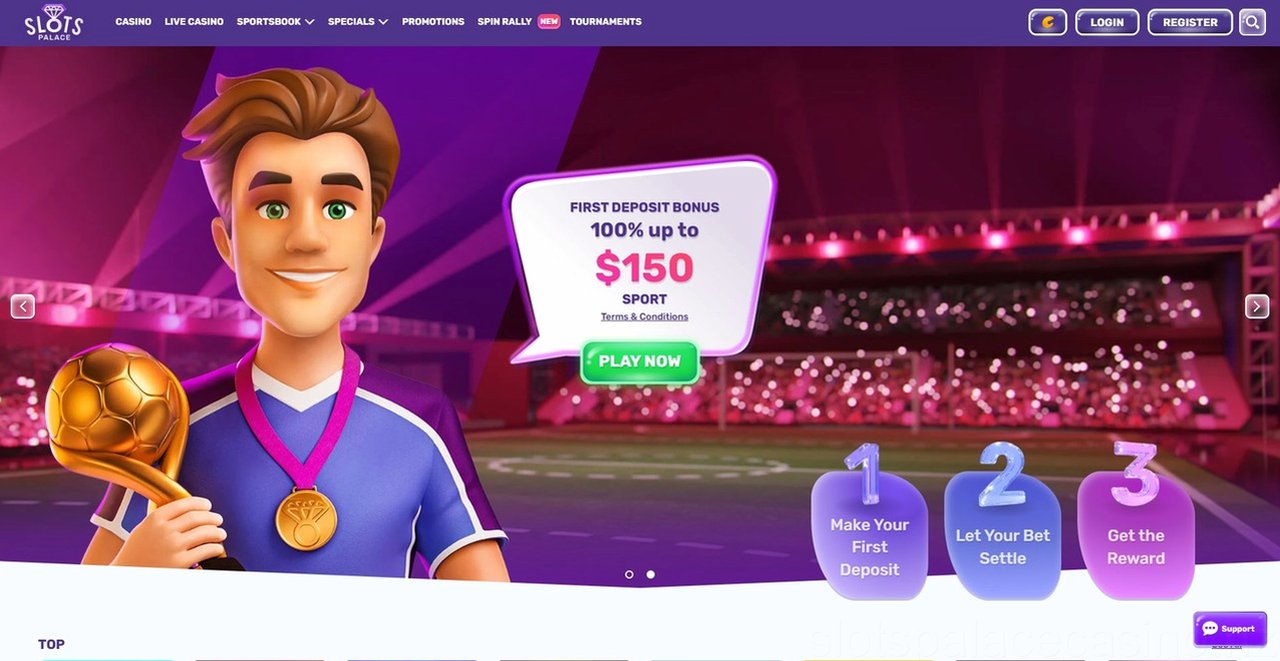
Bonus structures are often the first thing players look at, but they are also the area where terms and conditions do the heaviest lifting. At Slotspalace, as with most offshore pokies platforms, the welcome offer typically combines a deposit match with free spins on selected pokies titles. The advertised headline percentage or spin count is only part of the story — the wagering requirement, maximum bet size during play-through, and game weighting all determine how realistic it is to convert a bonus into withdrawable funds.
Welcome bonus package
New players signing up at Slotspalace Casino can typically expect a multi-part welcome package rather than a single bonus. This usually spans the first two to four deposits, with each stage offering a different match percentage and spin allocation. It's worth reading the promotional page closely, since minimum deposit thresholds and maximum bonus caps vary by tier.
Ongoing and reload promotions
Beyond the welcome package, operators in this space commonly run weekly reload bonuses, cashback offers on net losses, and pokies tournaments with leaderboard prizes. These promotions tend to carry their own separate wagering conditions, so it is worth treating each one as a distinct offer rather than assuming the same rules apply throughout.
The table below illustrates the kind of bonus structure typically found at platforms like Slotspalace. Exact figures change over time and should always be confirmed on the operator's own promotions page before opting in.
| Bonus type | Typical structure | Common condition |
|---|---|---|
| Welcome package | Deposit match + free spins across first deposits | Wagering requirement 30x-45x bonus |
| Reload bonus | Smaller match percentage, weekly cadence | Time-limited, often 7 days to clear |
| Cashback | Percentage of net losses returned | Usually paid as bonus funds, not cash |
| Free spins | Fixed spin count on a nominated pokie | Winnings capped or subject to wagering |
When comparing bonus offers across any offshore platform, a short checklist helps separate genuinely useful promotions from ones that look generous on the surface but are difficult to clear in practice.
- Check the wagering requirement multiplier and whether it applies to the bonus only or bonus plus deposit.
- Look for a maximum bet limit while a bonus is active — exceeding it can void winnings.
- Confirm which pokies contribute fully to wagering; table games often contribute far less or nothing.
- Note the bonus expiry window, since unused bonus funds are typically forfeited after a set number of days.
- Check whether withdrawal caps apply to bonus-derived winnings.
Wagering Explained
Wagering requirements are the mechanism that prevents bonus funds from being withdrawn immediately after being credited. In practical terms, a 35x wagering requirement on a NZ$100 bonus means a player must generate NZ$3,500 in total bets before any resulting balance becomes withdrawable. This is standard practice across the offshore pokies industry and is not unique to Slotspalace, but the exact multiplier and structure still deserve scrutiny before opting into any offer.

Game contribution rates are just as important as the headline multiplier. Most pokies contribute 100% toward wagering, meaning every dollar staked counts fully. Table games such as blackjack or roulette often contribute a much smaller percentage — sometimes as little as 5-10% — because their lower house edge makes them a less profitable path toward clearing a bonus for the operator. Progressive jackpot pokies are also commonly excluded from wagering contribution altogether.
It is worth understanding a few recurring pitfalls that catch out players who don't read bonus terms closely before depositing.
- Playing an excluded or low-contribution game while a bonus is active can waste wagering progress entirely.
- Withdrawing any portion of a deposit linked to an active bonus can void the remaining bonus funds.
- Some bonuses require the deposit itself to be wagered alongside the bonus amount, effectively doubling the real target.
- Missing the expiry date forfeits both the bonus and any accrued bonus winnings.
Reading the full bonus terms before opting in — rather than relying on the promotional summary — remains the single most useful habit for anyone using bonus offers at Slotspalace Casino or comparable operators.
Overview
Slotspalace positions itself as a pokies-focused online platform aimed at an international audience that includes New Zealand players. Like the majority of operators in this segment, it operates entirely offshore, meaning the servers, corporate entity and licensing arrangement sit outside New Zealand's jurisdiction. This is the current norm for essentially all online casino platforms accessible to Kiwi players, simply because New Zealand has not yet issued its own domestic licences.
The account registration process at Slotspalace typically follows the pattern used across the offshore casino industry: email verification, basic personal details, and — before any withdrawal is processed — a know-your-customer (KYC) identity check. This usually requires a photo ID document and sometimes proof of address or a payment method verification. This step exists to comply with the operator's own anti-money-laundering obligations under its licensing framework, not because of any New Zealand requirement, since no NZ regulatory framework yet applies to offshore sites.
What a typical account journey looks like
Understanding the general account lifecycle helps set expectations before signing up anywhere, including at Slotspalace.
- Registration with email and basic personal details, followed by email confirmation.
- First deposit via a supported payment method, often triggering a welcome bonus prompt.
- Identity verification requested before or at first withdrawal request.
- Withdrawal processing time that varies by payment method, typically faster for e-wallets and crypto than card or bank transfer.
Interface language and currency support also matter for NZ players. Some offshore platforms display NZD as a selectable currency, while others default to USD or EUR, which introduces a conversion step and potential currency fluctuation on deposits and withdrawals. It is worth confirming currency handling directly on the cashier page before committing funds.
Key Facts
- Licence
- Offshore gambling licence (e.g. Curacao-style framework)
- NZ authorisation
- None — no DIA licence yet exists
- Game focus
- Pokies-heavy, plus table games & live dealer
- Payments
- Card, e-wallets, cryptocurrency, bank transfer
- Withdrawal time
- Faster for e-wallets & crypto than card/bank
- Currencies
- NZD, USD or EUR (varies by platform)
- Minimum age
- 18 and over
Game Library
The core appeal of a platform like Slotspalace for most Kiwi players is the pokies library. Offshore casinos of this type typically aggregate content from multiple software studios rather than developing games in-house, which means the actual game selection depends heavily on which providers the operator has integrated.
Pokies remain the dominant category by volume, generally supplemented by a smaller selection of table games (blackjack, roulette, baccarat variants), video poker, and sometimes a live dealer section streamed from a studio. Progressive jackpot pokies — networked titles that pool a portion of every stake across multiple casinos into a shared prize — are also commonly featured, though these often carry lower base RTP in exchange for the jackpot potential.
Common provider categories found at pokies-focused platforms
While the exact provider list at any given operator changes over time, most offshore pokies platforms draw from a recognisable pool of established studios. The table below outlines the type of coverage typically expected, rather than a confirmed exhaustive list for Slotspalace specifically.
| Provider category | Typical content | What to check |
|---|---|---|
| Major international studios | Branded and original pokies with wide RTP range | Confirm RTP listed in-game info panel |
| Jackpot networks | Progressive pokies with pooled prize pools | Base RTP often lower than standalone titles |
| Live dealer studios | Blackjack, roulette, baccarat streamed live | Check table limits suit your bankroll |
| Niche/independent studios | Smaller catalogues, unique mechanics | Verify RNG certification is disclosed |
Fairness verification is worth understanding at a mechanical level. Reputable pokies providers have their random number generators (RNG) independently tested by accredited labs such as iTech Labs or eCOGRA, which certify that outcomes are statistically random and that the advertised return-to-player (RTP) percentage matches long-run performance. When a game lists its RTP in the information panel, that figure should reflect independent testing rather than the operator's own claim alone. Players comparing pokies across a library can use RTP as one factor, understanding it describes long-term theoretical return over millions of spins, not a guarantee for any individual session.
How casino game mechanics work
Understanding what actually happens behind a pokies spin helps demystify outcomes and separates informed play from guesswork. Every certified online pokie relies on a random number generator, a piece of software that continuously produces sequences of numbers with no predictable pattern. When a player presses spin, the RNG output at that exact moment determines the reel result — there is no "due" jackpot and no way to predict or influence the next outcome based on previous spins.
Return-to-player percentage is a theoretical, long-run statistic calculated over millions of simulated spins during game development and testing, not a promise for any single session. A pokie with a 96% RTP is mathematically designed to return NZ$96 for every NZ$100 wagered across its full lifetime of play, with the remaining 4% representing the house edge. Short-term results can and do vary enormously in either direction from that average, which is why RTP should be read as a comparison tool between games rather than an expectation of personal return.
Volatility (sometimes called variance) describes how a pokie distributes its wins rather than how much it pays overall. A low-volatility pokie tends to produce smaller, more frequent wins, which suits players preferring steadier balance movement. A high-volatility pokie pays less often but with larger potential wins when they land, suiting players comfortable with longer dry spells in exchange for bigger swings. Neither structure is inherently better — the right choice depends on bankroll size and personal risk tolerance.
Independent certification is what turns these mechanics from a marketing claim into a verifiable fact. Testing labs such as iTech Labs or eCOGRA audit RNG software and RTP tables against the certificate the operator publishes, confirming the game behaves as documented rather than being adjusted arbitrarily. When a pokie displays a certification badge or lists RTP transparently, that is a signal the title has gone through this external check, which is a more meaningful safety indicator than the platform's own marketing copy.
Banking
Payment flexibility is one of the more practical concerns for New Zealand players, particularly since some local banks apply restrictions or additional scrutiny to card transactions directed at offshore gambling sites. This has made e-wallets and cryptocurrency increasingly relevant as alternatives when a bank card transaction is declined or delayed.
Deposit processing is generally instant across most payment types, while withdrawal timing varies considerably. E-wallets and cryptocurrency withdrawals tend to process faster — often within hours to a day once KYC is cleared — while bank transfers and card refunds can take several business days. It's worth checking any minimum and maximum transaction limits before choosing a method, since these can differ significantly between deposit and withdrawal directions.
| Payment method | Typical use case | NZD relevance |
|---|---|---|
| Visa/Mastercard | Common deposit method | Some NZ banks flag or block gambling transactions |
| E-wallets | Faster withdrawal alternative | Availability depends on operator's cashier |
| Cryptocurrency (BTC, ETH, USDT) | Bypasses bank restrictions, faster settlement | Volatility risk between deposit and withdrawal |
| Bank transfer | Larger withdrawal amounts | Slower processing, several business days |
Visa · Mastercard · E-wallets · Bitcoin · Ethereum · USDT · Bank transfer
Cryptocurrency in particular has become a practical workaround for Kiwi players whose bank has blocked gambling-related card transactions, since crypto transfers don't route through the traditional banking rails that flag such payments. That said, crypto carries its own considerations, including exchange rate volatility between the time of deposit and withdrawal, and the need to use a reputable exchange to acquire and cash out funds safely.
A few banking pitfalls are worth flagging for anyone using an offshore platform like Slotspalace.
- Some NZ banks decline gambling-coded transactions outright, regardless of the operator's legitimacy.
- Withdrawal requests are commonly held until identity verification documents are approved, which can add delay to a first cashout.
- Currency conversion fees may apply if the platform's cashier operates in USD or EUR rather than NZD.
- Maximum withdrawal limits per transaction or per week can extend how long it takes to cash out a large balance.
Licensing & Safety
This is the section that matters most for New Zealand readers, because the legal landscape is genuinely changing and it is easy to find outdated or misleading information online. As of the time of writing, New Zealand does not have any DIA-licensed online casino operator. The Online Casino Gambling Act 2026, which comes into force on 1 May 2026 and is administered by the Department of Internal Affairs (DIA) / Te Tari Taiwhenua, establishes the country's first domestic online casino licensing regime. Up to 15 licences are being allocated during 2026, with licences issued from 1 December 2026 and the full regime expected to be operational in 2027.
Slotspalace Casino, like every other platform currently accessible to New Zealand players, operates under a foreign or offshore gambling licence rather than a New Zealand one. Offshore licensing authorities commonly referenced in this industry include the Malta Gaming Authority (MGA), various Curacao-based frameworks, and the Kahnawake Gaming Commission. These are legitimate regulatory bodies in their own jurisdictions, and a licence from any of them means the operator has met that authority's specific requirements around fund segregation, RNG testing and dispute handling. However, none of these licences constitute New Zealand authorisation, and it would be inaccurate to describe Slotspalace or any comparable operator as "licensed in New Zealand" or "regulated by the DIA" — no such status currently exists for any operator.
What this means practically for Kiwi players
It is not a criminal offence for an individual New Zealander to play at an offshore casino site — the current law targets operators and advertisers rather than players. However, choosing to play offshore does carry real trade-offs that are worth understanding clearly before depositing any money.
- No New Zealand regulator oversees offshore platforms, so any dispute is resolved under the foreign licensing authority's process, if at all.
- There is no New Zealand-based ombudsman or regulator to escalate a complaint to if an offshore operator delays or refuses a withdrawal.
- Consumer protections that will eventually apply to DIA-licensed operators — such as mandated responsible gambling tools and local dispute mechanisms — do not yet apply to any currently available platform.
- Recreational gambling winnings are not taxed in New Zealand, which remains true regardless of whether an operator is offshore or (eventually) DIA-licensed.
Fairness and security fundamentals are still worth checking even in the absence of NZ-specific oversight. Look for SSL encryption on the site (visible via the padlock icon and https:// in the browser bar), which protects data in transit between your device and the operator's servers. Independent RNG and RTP certification from a recognised testing lab, such as iTech Labs or eCOGRA, is another meaningful signal that a platform's games have been externally audited rather than simply advertised as fair.
Snapshot: licensing status comparison
| Licensing type | Current status for NZ players | What it covers |
|---|---|---|
| Offshore licence (MGA, Curacao, Kahnawake) | What Slotspalace and similar operators currently hold | Foreign regulatory compliance only, no NZ authority |
| DIA online casino licence | Not yet issued; expected from 1 December 2026 | Will require NZ-specific consumer protections once live |
| No licence at all | Unregulated operators exist and should be avoided | No independent oversight whatsoever |
Given this environment, the most useful due-diligence habit for any Kiwi researching Slotspalace or a comparable platform is to verify the licence number displayed against the issuing authority's own public register, check for independent RNG/RTP certification, and confirm SSL encryption is active before entering any payment details.
Responsible Gambling
Responsible gambling information is not a formality — it is a core part of making an informed decision about whether, and how, to engage with any online casino platform, offshore or otherwise. Online casino play in New Zealand is restricted to those aged 18 and over, and this age threshold applies regardless of which platform, including Slotspalace, a person is using.
New Zealand's free national gambling support service is available to anyone who needs it. The Gambling Helpline can be reached on 0800 654 655, or by texting 8006, and operates seven days a week at no cost. Further information and self-assessment tools are available at safergambling.org.nz. In an immediate crisis or emergency situation, call 111.
Because Slotspalace operates offshore rather than under a New Zealand licence, the self-exclusion tools available are those provided directly by the operator itself — typically account-level deposit limits, loss limits, time-outs, temporary self-exclusion periods, or full account closure requested through the platform's support channels. These tools vary in how thoroughly they are enforced from one offshore operator to another, which is an inherent limitation of the current unregulated environment.
For players wanting a stronger layer of control that doesn't rely solely on an individual operator's internal systems, independent software-based blockers such as Gamban or GamBlock can restrict access to gambling sites across a device or network, regardless of which platform a person might otherwise be tempted to use. These tools operate independently of any single casino's cooperation.
It is important to be accurate about where New Zealand's regulatory protections currently stand. A national online self-exclusion register is mandated under the incoming regime, with a deadline of December 2027, but this register is not yet live. No current mechanism exists that automatically blocks a New Zealander from accessing an offshore platform like Slotspalace through a centralised national system — until that register is operational, self-management tools and independent blockers remain the practical options available.
A short set of practical habits can help keep pokies play within a manageable and enjoyable frame, regardless of which platform is used.
- Set a deposit limit before playing, and treat it as a hard cap rather than a suggestion.
- Avoid chasing losses by increasing bet size after a losing session.
- Track time spent playing using the platform's session reminders, if available, or an external timer.
- Treat any bonus or promotion as a feature of the game, not a reason to deposit beyond a planned budget.
- Reach out to the Gambling Helpline early if gambling starts to feel less like entertainment and more like a compulsion.
How to Start Playing
- Register with your email and basic personal details, then confirm via the email link.
- Make a first deposit using a supported payment method, which often triggers a welcome bonus prompt.
- Complete identity verification (KYC) — requested before or at your first withdrawal request.
- Request a withdrawal; processing time varies by method, typically faster for e-wallets and crypto than card or bank transfer.
Pros & Cons
Pros
- Pokies-heavy game library aggregated from multiple established studios.
- Multi-part welcome package plus ongoing reloads, cashback and tournaments.
- Card, e-wallet and cryptocurrency payment options, with crypto bypassing bank blocks.
- Faster withdrawals for e-wallets and crypto once KYC is cleared.
- Account-level responsible gambling tools (limits, time-outs, self-exclusion, closure).
- Recreational gambling winnings are not taxed in New Zealand.
Cons
- Operates under an offshore licence, not New Zealand authorisation.
- No New Zealand consumer protection or local dispute resolution pathway.
- Wagering requirements (30x-45x) and bonus terms require close reading.
- Some NZ banks flag or block gambling-coded card transactions.
- Currency conversion may apply if the cashier operates in USD or EUR.
- National self-exclusion register is not live until December 2027 at the earliest.
About the Author
Frequently Asked Questions
Is Slotspalace Casino licensed in New Zealand?
No. No online casino currently holds a New Zealand licence, because DIA licences under the Online Casino Gambling Act 2026 are not issued until 1 December 2026 at the earliest. Slotspalace operates under an offshore licensing framework, which is not New Zealand authorisation.
Is it illegal for a New Zealander to play at Slotspalace?
Current New Zealand law targets operators and advertisers rather than individual players, so playing at an offshore site is not a criminal offence for the player. However, offshore play comes without New Zealand consumer protections or a local dispute resolution pathway.
Are my winnings at Slotspalace taxed in New Zealand?
Recreational gambling winnings are not taxed in New Zealand, regardless of whether the platform is offshore or, eventually, DIA-licensed.
What payment methods work best for NZ players at offshore platforms?
E-wallets and cryptocurrency tend to process faster and avoid the card-blocking issues some NZ banks apply to gambling-coded transactions, though bank transfer and card options are also commonly available.
How is game fairness verified at a platform like Slotspalace?
Reputable pokies rely on independently tested RNG software and published RTP figures, certified by labs such as iTech Labs or eCOGRA, rather than relying solely on the operator's own claims.
What should I do if I want to stop playing?
Use the operator's own account limits, self-exclusion or closure tools, consider an independent blocker like Gamban or GamBlock, and contact the Gambling Helpline on 0800 654 655 (or text 8006) for free, confidential support seven days a week.
What is a wagering requirement and how does it work?
Wagering requirements prevent bonus funds from being withdrawn immediately. A 35x wagering requirement on a NZ$100 bonus means a player must generate NZ$3,500 in total bets before any resulting balance becomes withdrawable. Most pokies contribute 100% toward wagering, while table games often contribute far less.
When will New Zealand have its own licensed online casinos?
The Online Casino Gambling Act 2026 comes into force on 1 May 2026 and is administered by the Department of Internal Affairs (DIA). Up to 15 licences are being allocated during 2026, with licences issued from 1 December 2026 and the full regime expected to be operational in 2027.